
Enrique Coll "Sinopoli" 1932

| Country : | Spain - Barcelona |
| Year : | 1932 |
| Scale length : | 65 cm |
| Top : | Spruce |
| Back & side | Brazilian rosewood |
| Fingerboard : | Ebony - 52 mm |
| Body length : | 490 mm |
| Body width : | 285/240/363 mm |
| Body depth | 92 / 100 mm |
| Weight : | 1 470 g |
| Action : | 2,9/3,2 mm |
| Condition : | Good condition, both in terms of restoration and playability |
| Price : |
On request |
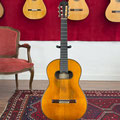

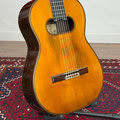

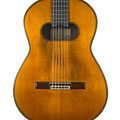

This rare guitar is interesting for several reasons: its provenance, construction, and sound.
Built by Enrique Coll in 1932, it is a “Sinopoli” model, a term that refers to its inventor, Antonio Sinopoli (1878–1964), an Argentine guitar teacher, virtuoso, and composer (Vidalita), who developed and patented this unique soundboard with an oval soundhole and a remarkable asymmetrical bracing pattern in which each of the eight bars is hollowed out, making the structure much lighter. The soundhole is not placed as high as on the “Moderna” models built by Francisco Simplicio in 1929, but the idea is essentially the same: to increase the vibrating surface of the top in order to enhance the instrument’s sound quality and volume.
Francisco Simplicio also collaborated with Antonio Sinopoli on the development of this design; a “Sinopoli” top, crafted by Francisco Simplicio, was used by luthier Manuel Ordonez (Córdoba) in 2019 to build a truly beautiful guitar.
Enrique Coll holds an important place in the history of Barcelona guitar making; he is credited with introducing Ignacio Fleta to the art of guitar making when they opened a workshop together in Barcelona and became partners for a few months in their first business. In this capacity, he represents the link between Francisco Simplicio and Ignacio Fleta.
The “Sinopoli” patent was used by several luthiers—Enrique Coll, of course, but also Antigua Casa Nuñez, Daniel Lago Nuñez in Argentina, and Del Vecchio in Brazil—making this model a sought-after classic of South American guitar making. However, to date, only one other “Sinopoli” guitar, built by Enrique Coll, has been offered for sale: it is number 2, also from 1932.
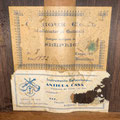
Enrique Coll sold many of his instruments in Argentina, which is also where this guitar comes from. After years of loyal service, it was restored at the Antigua Casa Nuñez workshop, most likely by Dionisio Gracia, a renowned luthier and successor to Francisco Nuñez, who knew this guitar model inside and out: did he not have to restore a 1912 Enrique Garcia guitar by replacing the original top with a “Sinopoli” top? (Russell Cleveland collection, "The Classical Guitar - A Complete History.")
More recently (2022), it underwent a superb restoration that has restored this “soon-to-be-centenarian” to full playability, structural integrity, and, above all, its rich tone for the next hundred years.
The guitar indeed possesses a full, powerful sound reminiscent of the guitars made by Santos Hernandez or Domingo Esteso during the same period. Its tone is very interesting: a blend of “traditional” sounds, familiar to those who know the guitars of Enrique Garcia or Francisco Simplicio, and, at the same time, a “modern” dimension, very contemporary, foreshadowing the early guitars of Ignacio Fleta with its confidence, clarity, and balance across the entire range.
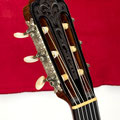
It is a refined instrument; the quality of craftsmanship, the details, and the design are of an exceptional standard. Simplicio’s influence is evident here once again in the “tallado” of the headstock, as can also be seen at the same time in the guitars of Ignacio Fleta. The tuning machines, identical to those used by Francisco Simplicio on his guitars, are original. A very beautiful, rare instrument in perfect playing condition that will delight both collectors and concertist.